What is dreamcore?
Dreamcore is an internet aesthetic that tries to capture how a dream feels — not just any dream, but those calm, slightly-off dreams you half-remember on waking: you were at school, but it wasn't your school; it was summer, but you didn't know which year; someone was with you, but they don't show up in the memory.
dreamcore is recognizing a place you've never been, and missing it.
It isn't horror. It doesn't want to scare you. It wants to leave you at that exact point between the comforting and the unsettling, where something is at once a fond memory and an unanswered question. Two English words worth learning: comforting and unsettling. At the same time. Always at the same time.
The ingredients
If you distil a thousand dreamcore images, almost all of them are built from pieces of this list:
| Element | Why it works |
|---|---|
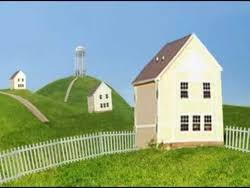
| The endless green field under an enormous sky (the sky fills 70% of the frame, the horizon flat and clean) | It's the Windows XP wallpaper turned into a real place. We've all seen it; nobody's been there. |
| The lone suburban house in the distance, white, too small | A house is shelter. A house alone in the middle of nowhere is a question. |
| Floating eyes scattered through the scene | The feeling of being watched inside a dream, made literal. Dreamcore's most iconic motif. |
| An ownerless red balloon | It implies a child who's no longer there. The party ended and nobody told you. |
| Cut-up rainbow fragments, like half-peeled stickers | The joy of childhood, but incomplete, misremembered. |
| Giant pink cotton clouds | The six-o'clock sky of a day that was good. |
| Doors and monoliths standing in the middle of the field | A threshold without a wall is an invitation. To where? Exactly. |
| The eternal light of a summer 3 p.m., with no shadows where there should be | The sun exists but time doesn't pass. It's the universe's nap time. |
| Low-res text over the image: "do you remember?", "we're almost there" | Someone (you?) is speaking straight to your memory. |
Texture matters as much as content
A sharp photo of a green field is a stock photo. That same photo overexposed, grainy, with the colours washed out like a 2003 print, is dreamcore. The aesthetic lives in deliberate imperfection:
- Cheap 3D renders from the PS2 / early-2000s era, with that involuntary uncanny valley that's impossible to fully fake today.
- Cheap-digicam or expired-film photos: blown out, out of focus, with orange dates in the corner.
- Desaturated pastel colours — like the old photo of a place, not the place itself.
- Visible JPEG compression, blurry interpolation, VHS.
What dreamcore is NOT
- It's not horror. No jumpscares, no blood, no monsters. If the image is trying to scare you, it's left the genre.
- It's not weirdcore. Weirdcore is its anxious sibling: saturated, noisy, deliberately uncomfortable. Dreamcore is pastel, ethereal, softly melancholic. We have a whole comparison.
- It's not just "liminal spaces". The liminal is the setting (the empty place of passage); dreamcore is the full dream-feeling, which can include the liminal plus impossible things — eyes in the sky, doors in the field. More in liminal spaces.
- It's not literal nostalgia. It's not a photo of your real childhood. It's childhood as a dream remembers it: with the furniture moved around.
And why do we like it?
There are several theories (we get into them on the page about the liminal), but the short version is this: dreamcore puts images to emotions that had no picture. The nostalgia for summers you never lived. The sense that childhood is a country you can't go back to. The internet gave it names (anemoia, kenopsia), and a whole generation said "ah, so it wasn't just me."