Liminal spaces
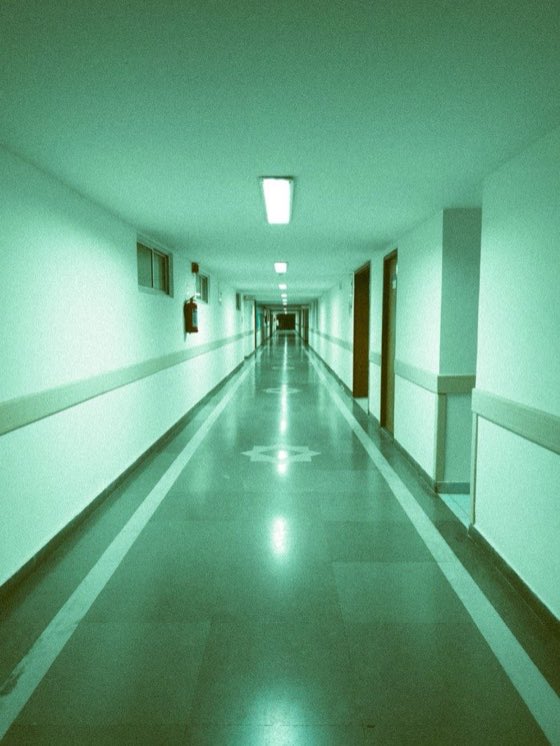
Limen, in Latin: threshold. A liminal space is a place of passage — built to be crossed, not to be stayed in. A hallway, a waiting room, a stairwell landing, an airport at 3 in the morning. When one of these places shows up empty, outside its hours, without the people who give it meaning, something odd happens: the place stays perfectly recognizable, but it no longer means anything. And that, for some reason, you feel in your stomach.
Why it unsettles (the three theories)
1. The context collapses
Your brain knows what a school is: noise, people, a schedule. An empty school at night fits the category "school" and violates it at the same time. That dissonance —familiar and impossible at once— is a close cousin of the uncanny valley: almost-right is worse than wrong.
2. The evolutionary alarm
A space made by and for humans, with no humans, sets off an ancient question: where is everyone? do they know something I don't? It isn't fear of what's there; it's unease about what's missing.
3. Memory of place
The places of passage of childhood (school hallways, entryways, shopping malls) are recorded as the background of memories, never as the leads. Seeing one empty, you recover the background without the memory — a frame with no photo. Hence the melancholy: you recognize the place, but can't find the moment. The technical-poetic name for this is kenopsia (see glossary).
The canon: classic liminal places
| Place | Its liminal hour |
|---|---|
| School hallway | At night, or in August |
| Shopping mall | Just after closing, music still playing |
| Hotel corridor | 4 a.m., every door identical |
| Airport / station | The last connection, the belts moving on their own |
| Indoor pool | Nobody around, the water perfectly still |
| Playground | In fog, the swings stopped |
| 24h laundromat | Any hour: a laundromat is always liminal |
| Highway rest stop | At dawn, in the middle of a long trip |
| Waiting room | When you no longer remember what you were waiting for |
Liminal ≠ dreamcore (but they're family)
This distinction matters and a lot of people mix them up:
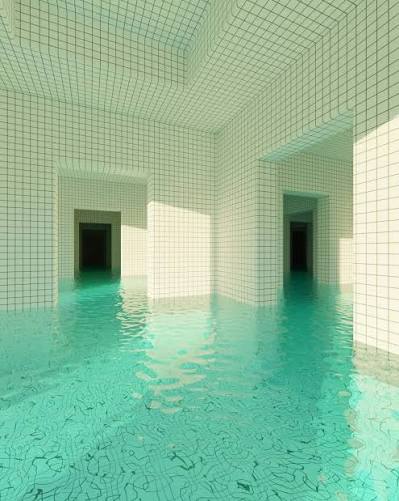
- Liminal space = the setting. A real (or photorealistic) place of passage, empty. The photo can be unedited; the effect comes from the place itself.
- Dreamcore = the full dream-feeling. It can use liminal settings — and it does, constantly — but it adds the impossible: eyes in the sky, endless fields, text that speaks to you. Dreamcore contains the liminal the way it contains pink clouds: as one of its materials.
the liminal is the hallway. dreamcore is what the hallway means inside the dream.
That's why this archive covers both: you can't explain dreamcore without the liminal, just as you can't explain a dream without the places it happens in.
The Backrooms: the branch that went to horror
The Backrooms (see history) were born from a liminal photo, but evolved toward horror: levels, entities, survival. They share DNA with dreamcore — the noclip, the carpet, the fluorescent hum — but the intent is opposite: the Backrooms want you to be afraid; dreamcore wants you to miss something. If the Backrooms are the nightmare, dreamcore is the nap.