The look
Dreamcore has surprisingly strict visual rules for a "dream" aesthetic. Here they are, distilled, in case you want to recognize them — or break them on purpose.
1. The palette: washed-out pastel
Desaturated colours, like a photo printed in 2003 and forgotten in a box. Nothing garish: the saturated and the strident belong to weirdcore. These are the archive's reference tones:
sky
light sky
grass
grass shadow
pink cloud
white house
Notice none of them is a "pure" colour: the sky isn't out-of-the-can blue, the grass isn't fluorescent green. Everything's a notch muted, as if seen through time.
2. The composition: the sky rules
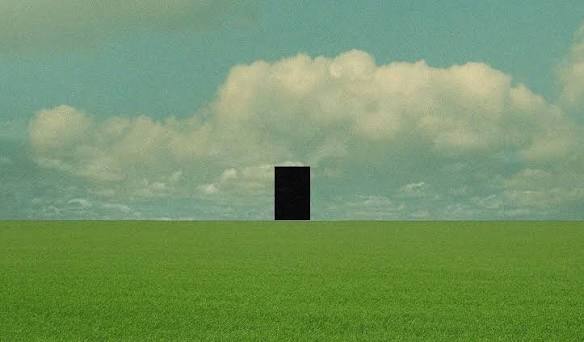
- The sky fills ~70% of the frame. This is THE rule. A low, flat horizon makes anything you place in the field look small and far away — which is exactly the feeling.
- A single subject. A house. A monolith. A swing. The object's solitude is what loads it with meaning.
- Broken symmetry. The frame almost centred but not quite, like a photo taken without looking.
- Nobody. People, if they appear, are turned away, far off, or silhouettes. Usually there's no one. The scene is waiting for you.
3. The light: the eternal 3 p.m.
Dreamcore light is summer-nap light: high, white, undramatic. No epic sunsets or photographer's chiaroscuro — that would be "pretty", and pretty scares the dream away. Signs of dreamcore light:
- Slight overexposure: blown-out whites, the sky almost textureless.
- Absent shadows where there should be some. The cheap render does it on its own; in a photo you have to hunt for it (bright-overcast noon).
- At night, its equivalent: fluorescent. Greenish, even, institutional light, like a school hallway after hours.
4. The texture: the file format of memory
A dreamcore image is never sharp. The decay is the message:
| Texture | Where it comes from |
|---|---|
| Grain and noise | Cheap 2003 digicam, expired film |
| Visible JPEG compression | An image forwarded a thousand times over MSN / forums |
| Low-poly render, stretched textures | PS2-era CGI, Windows screensavers |
| VHS lines, orange date in the corner | Home video, re-recorded tapes |
| Soft motion blur | The photo taken while walking, by accident |
5. The motifs: the visual dictionary
The genre's recurring objects, in rough order of iconicity: floating eyes · doors and monoliths in the field · red balloons · rainbow fragments · pink cotton clouds · lone suburban houses · empty or flooded pools · endless hallways · playgrounds with no children · TVs on with no signal · suns with faces (inherited from children's books) · pixelated text that speaks to you.
Typography
The text inside dreamcore images uses old system fonts: low-res Times New Roman, Courier, or the eternal Comic Sans — because they're the fonts of school posters, family PowerPoints, corner-shop signs. Fonts no one designed for you, but that were everywhere when you were seven.